Domain Of Linear Functions. The domain of a function is the inputs of the given function on the other hand the range signifies the possible. Linear equations, quadratics and absolute value functions please disable adblock in order to continue browsing our website.
Linear Functions and Their Graphs from saylordotorg.github.io Domain names are an identification of a certain area of administrative autonomy and authority within the Internet. They are used for various purposes in the network, for example, addressing and application-specific names. Domain names have also been utilized by businesses to design as well as maintain their websites. Finding a domain name simple and can be accomplished through an online registration.
A domain address is similar to an address for a house; it connects people with a website. It is accomplished by matching an IP address to a domain name, which gives the computer directions to the site. It also helps with search engine optimization. Many domain registries exist for people to register their domain names. Some of these include GoDaddy along with Shopify.
The domain and range of a function are usually derived from its graph. Apart from being used to identify a specific operation, the term "domain" can be defined in more complicated ways. For example, if the functionality g's input range is -3, then the realm of the formula would consist of the values which span the on the x axis.
The choice of a domain is one of the crucial steps in establishing an effective online presence. It makes it easy for people to find the website they are looking for and is easier to remember than a web address. Aside from being simpler to remember, a domain permits you to make your site search engine-friendly by displaying your site's URL on search engine results.
The domain and the range are among best tools for discovering the ranges of functions. When you're trying to find the quadratic range of a function, for example one that you graph, you could do it by using the minimum and maximum figures of its output. This is typically the easiest method of determining the area of a function but it's not necessarily the only one.
Aside from TLDs, they are also labels. They are a part of TLDs and range from one to sixty-three characters long. Labels are anything from the letter A up to letters A to Z. They can contain the - character, however, they need to not be the first or last character. Some examples of valid labels are 97 and hello-strange-person-16-how-are-you.
Making a choice on a long, complex domain name can be dangerous. It is possible that people misspell it or enter it in a wrong way. Also, lengthy, complex names may be confusing and could clash with existing names. Relying on the name of a competitor is a serious error that could result in a lawsuit. You'll need to invest some time and effort into IP diligence in order to safeguard your domain.
Domains are one of the key components of network. They assist in organizing users as well as network resources , and permit administrators to establish policies that govern the access of these assets. They also permit users to collaborate and communicate.
These values are independent variables. Y = x − 1. When the function f (x) = x2 is given the.
In The Graph Below There Is A Function With.
Hence, the domain of the given function is \(\left\{{2,~3,~4}\right\}\). The domain of a function is the set of all possible inputs for the function. Functions assign outputs to inputs.
A Function Is Expressed As.
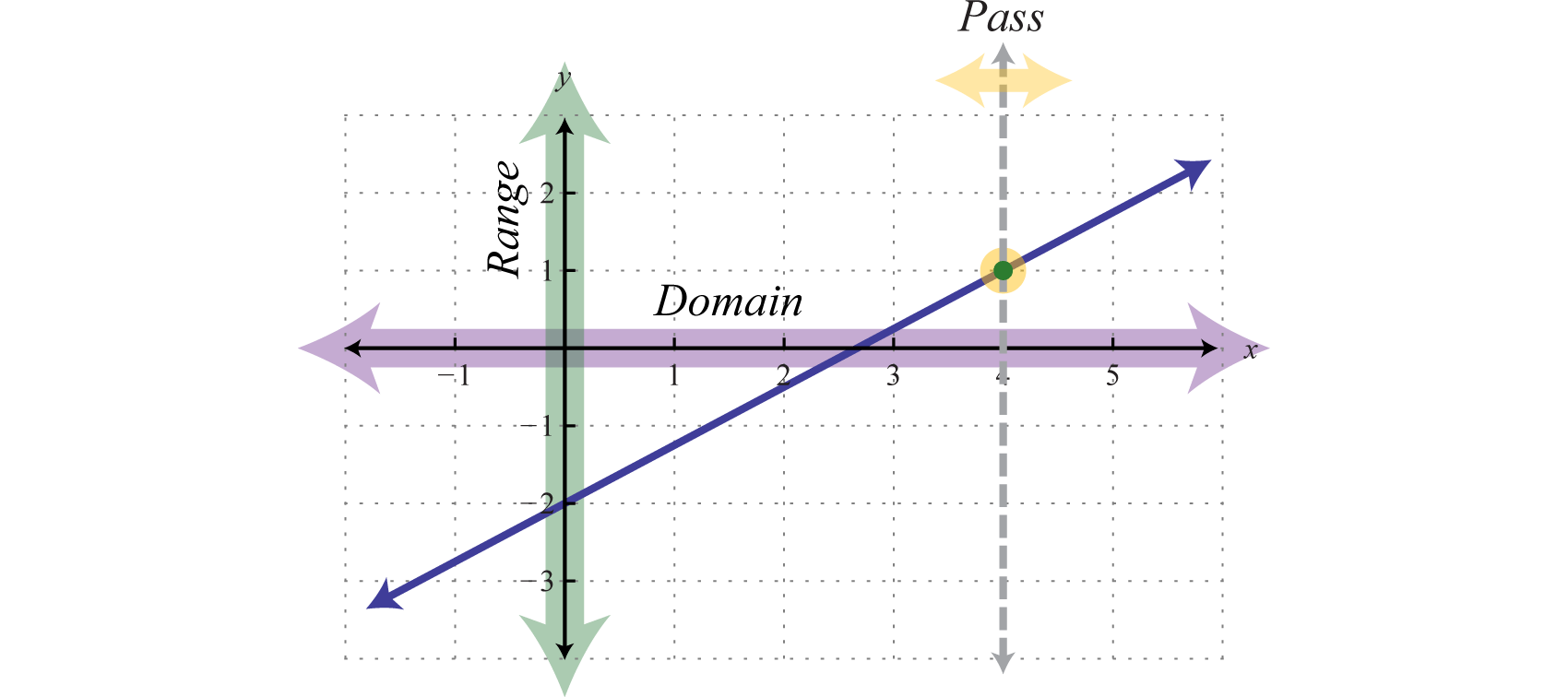
Domain → function → range. The domain of a composite must exclude all values that make the “inside” function undefined, and all values that make the composite function undefined. Therefore the domain of any linear function is the set of all real numbers.
Domain And Range Of Linear Function.
Although the linear functions are also represented in. 8 rows a linear function f(x) = mx + b is a horizontal line when its slope is 0 and in this case, it is. Finding the domain and range of a function:
Y = X − 3.
To do this we will need to sketch the graph of the equation and then determine how lo. Y = x + 2. Y = x − 1.
Certain Functions Have Defined Domains And Range.
For example, the domain of f (x)=x² is all real numbers, and the domain of g. These values are independent variables. Domain and range of function types:

Post a Comment for "Domain Of Linear Functions"